The successful Artemis II mission has boosted confidence in India's upcoming Gaganyaan mission, as both aim to demonstrate similar spaceflight capabilities. Experts highlight the collaboration between ISRO and NASA and the shared training programmes for astronauts.

India is set to take its first steps towards its own human space flight when the uncrewed Gaganyaan mission soars to the skies later this year. Private players in the space sector are also gearing up for launching satellites on home-built rockets.

Astronaut Shubhanshu Shukla discusses the Gaganyaan mission and its potential to inspire other nations in space exploration, drawing on his experiences as an IAF test pilot and his time on the International Space Station.

ISRO's Thiruvananthapuram-based Vikram Sarabhai Space Centre successfully conducted a series of drogue parachute deployment tests at the rail track rocket sled facility of the Terminal Ballistics Research Laboratory in Chandigarh during August 8-10.
Rigorous testing demonstrates the engine's mettle, it said, adding the CE20 engine identified for the first uncrewed flight LVM3 G1 also went through acceptance tests.
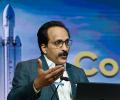
His statement came a day after the ISRO successfully launched its TV-D1 test vehicle ahead of the human space flight mission Gaganyaan.
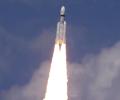
For the Gaganyaan programme, LVM3 rocket is re-configured to meet the human rating requirements and has been christened as 'Human Rated LVM3', ISRO said and it would be capable of launching the Orbital Module to an Low Earth Orbit of 400kms.
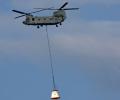
ISRO successfully conducted the first Integrated Air Drop Test (IADT-01) to validate the parachute-based deceleration system for the Gaganyaan mission, demonstrating a crucial step towards India's human spaceflight program.
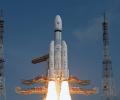
ISRO Chairman V Narayanan has emphasised the critical role of mission operations in ensuring the success of India's expanding space programme. He highlighted this at the Spacecraft Mission Operations conference, noting the importance of sustained teamwork and operational precision, particularly for long-duration missions like Chandrayaan-3 and the upcoming Gaganyaan programme.

When asked if it would be possible to achieve the Gaganyaan mission with the given time frame, Sivan said, "Yes, we are not doing this for the first time, and we are also not starting the mission from the scratch. We are already on the job," adding that several important procedures, like the crew module, crew escape systems, environment control and life support systems, had already been completed.
Currently, some of the rocket hardware for the human space programme has reached the Satish Dhawan Space Centre in Sriharikota and the integration of the crew module was going on at the Vikram Sarabhai Space Centre, Trivandrum, ISRO chairman S Somanath said.

He unveiled the country's ambitious space project's timeline during a media interaction.

ISRO has announced plans for seven launch missions by March, including the first uncrewed mission for the Gaganyaan project and demonstrations of new satellite technologies.

From a surge in startups to crewed mission preparations, 2025 marks a transformative year as India eyes $44 billion space economy by 2033.

Astronaut Shubhanshu Shukla returns to Earth after an 18-day mission aboard the International Space Station, marking a significant milestone for India's space program and carrying out crucial scientific experiments.

Scientists are working on conducting various tests for the ambitious Gaganyaan mission and the agency is coordinating with the Navy and others in this connection, he said.
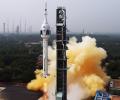
Chandrayaan-4 will involve at least two separate launches of the heavylift LVM-3 rocket that will carry five different components of the mission which will be assembled in orbit.

The Human-rated LVM3 vehicle, the Crew Escape System and the Crew Module and Service Module are all in final stages of testing and integration.
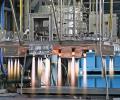
With these successful tests, ISRO has moved a step closer to India's first human spaceflight mission, Gaganyaan.

Indian Space Research Organisation (ISRO) will conduct three more test vehicle missions under the ambitious Gaganyaan programme after the maiden TV-D1 test flight, which is scheduled on October 21, the space agency's chairman S Somanath has said.
The test vehicle development flight (TV-D1) will be conducted at the Satish Dhawan Space Centre in Sriharikota in Andhra Pradesh to test the crew module that is scheduled to house Indian astronauts during the human spaceflight late next year.

ISRO aims to send humans into space on a Low Earth Orbit of 400 km for a three-day mission and bring them safely back to earth.
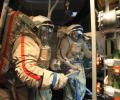
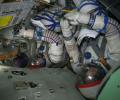
Four Indian Air Force fighter pilots are currently under training in Moscow, and are likely to be potential candidates for the Gaganyaan project.

The test vehicle development flight (TV-D1) is aimed at testing the crew module that will carry Indian astronauts during the human spaceflight late next year.

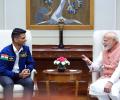
Modi welcomed Shukla, who was wearing an ISRO astronaut's jacket, with a warm hug and walked with him with his arm on the astronaut's shoulder.
ISRO Chairman V Narayanan announces ambitious space program goals, including landing Indians on the Moon by 2040 and launching the 'Gaganyaan' mission in 2027. The agency is also working on a national space station and uncrewed missions.

The RusBeam 2800 is now India's largest electron-beam wire deposition 3D printer operating under vacuum. The machine was custom-built for India and is operated with software developed by Rosatom.

In a written reply, Singh said NASA has identified a private entity Axiom Space and ISRO had signed a Space Flight Agreement with the American firm for the joint mission to the International Space Station.

IAF's four fighter pilots undergoing rigorous training for the landmark Gaganyaan mission, and who earned the 'astronaut wings' on Tuesday, have a stellar resume. They have a flying experience in the range of nearly 2,000-3,000 hours and two of them are recipients of the prestigious 'Sword of Honour'.

The first test-flight will be followed by sending a female-looking spacefaring humanoid robot -- Vyom Mitra -- in outer space likely next year.

These upcoming launches carry added significance in light of setbacks suffered in recent years.
Shukla said the two missions presented a major opportunity for the country and the sustained commitment of the government to the space sector, despite setbacks such as the Chandrayaan-II mission was laudable.
The mission is targeted for launch in the fourth quarter of 2024.
The Gaganyaan mission aims to send a three-member crew to space for a period of five to seven days by 2022 when India completes 75 years of Independence.

Training modules also cover academic courses, Gaganyaan flight systems, nicro-gravity familiarisation through parabolic flights, recovery training, mastering of flight procedures and training on crew training simulators, according to ISRO sources.

President Droupadi Murmu addressed Parliament, urging unity on national issues like 'Viksit Bharat', swadeshi, and national security. She highlighted government initiatives and the nation's progress.

Weighing 6,100 kg, the communication satellite would be the heaviest payload to be placed into the Low Earth Orbit (LEO) in LVM3 launch history from Indian soil.

Air Force sources said 25 test pilots were part of the initial selection process.

Vyomamitra, a combination of two Sanskrit words Vyoma (Space) and Mitra (Friend), took everyone by surprise when she introduced herself to the audience gathered there.

The Bharatiya Antariksh Station represents the next phase of India's human spaceflight ambitions, enabling long-duration presence in space, advanced microgravity research and technology development, and supporting future human exploration missions.
